My fourth album “Heading West” is an interpretation of the landscape and peoples of the American west through the senses of a travelling Brit. I wanted to express the emotions of my experiences and to convey the character of the places that I visited, although some of the music I composed turned out to be more abstract than that.
One example of this is my song “Hope”. I’ve had some really lovely comments about this song which is always nice because you never know whether or not what you are doing is perhaps a cliche – the listener always decides this of course. “Hope” is not easy to describe, which is why I gave the song that title after I had composed and recorded it – if one word can describe an abstract thing like a piece of music, then “Hope” was it in this instance.
When it came to putting together a video for this song, I started trawling aimlessly on the internet looking for inspiration. It wasn’t long before the amazing photographs of Dorothea Lange jumped out at me as the perfect representation of what the song is about.
Dorothea Lange (1895 – 1965) was an amazing American documentary photographer and photojournalist, best known for her depiction of the Great Depression era which affected the world in the decade immediately preceding World War II. Lange’s photographs humanized the consequences of the Great Depression in the American west and documented the migration of so many people intent on finding work and a place for themselves and their families.
In 1941 Lange was awarded a Guggenheim Fellowship for her excellence in photography.
The picture on the video thumbnail is entitled Migrant Mother, and the woman is Florence Owens Thompson. Look her up on wikipedia, the story of how the picture came to be taken and of her life is fascinating. I hope you like the video and the music.
This is the place, according to Welsh legend, where the red dragon of the Celts fought with the white dragon of the Anglo-Saxons. Both fell into the lake, but only the red dragon emerged, and this is why the red dragon is the national emblem of Wales and appears on the national flag. But that’s only a story, albeit a nice one. I have written the management plan for this place and this will hopefully help to conserve the wonderful wildlife and the cultural landscape for the future. And it in turn has inspired some of my music.
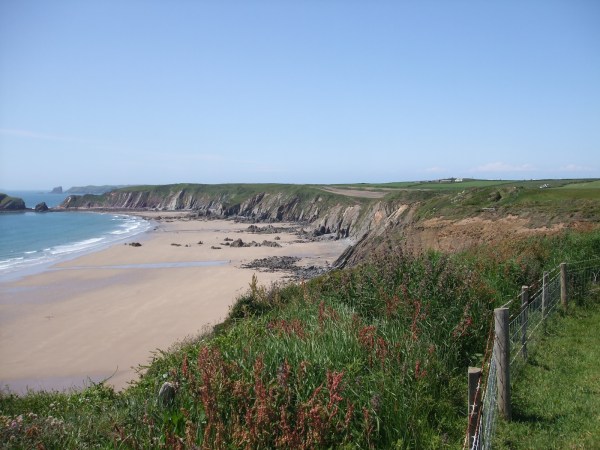
After 6 months of perpetual grey skies and torrential rain, spring has finally arrived on the Pembrokeshire Coast, and today our local beach looks like this. It’s so nice to finally feel some warm sunshine, although admittedly there is still a chilly north-easterly wind coming down from the arctic.
Puffins on Skomer Island, Pembrokeshire Photo: Mike Alexander
The sea birds have arrived back from the South Atlantic to breed on the offshore islands of Skomer, Skokholm, Grassholm and Ramsey. These puffins nest in dis-used rabbit burrows on the islands, which are free of predators like rats and foxes, although the threat from the Great Black-backed Gull is still very real for the offspring of these little fellas.
Photo: Mike Alexander
The gannets have returned from their winter feeding grounds in the south to breed in huge numbers (32,000 nesting pairs) on Grassholm Island, and can be seen diving into the sea wherever they spot shoals of fish on which to feed.
Photo: Mike Alexander
In the next few weeks all of the spring flowers will emerge as the land awakens from its winter slumber. The most familiar birds to be seen from the cliff tops are razorbills, guillemots, kittiwakes, fulmars and various species of gull, as well as shags, cormorants and the rarer choughs and peregrine falcons.
My music is often derived from and about some of the lovely places and wildlife of the Pembrokeshire Coast National Park in West Wales, where I have worked as an ecologist for 20 years. I hope it is possible to hear the influence of this landscape in my song, which was deliberately written in a style evoking a kind of “national anthem for nature”, if that makes any sense? Anyway I hope you like it 🙂 The song is from my album “Round River”.



 Mike Howe