I am an ecologist and a composer of guitar based instrumental melodies signed to the Real Music label in California. I like to write about my work, music and nature conservation and how it all comes together. I try not to write about things I don't know much about.
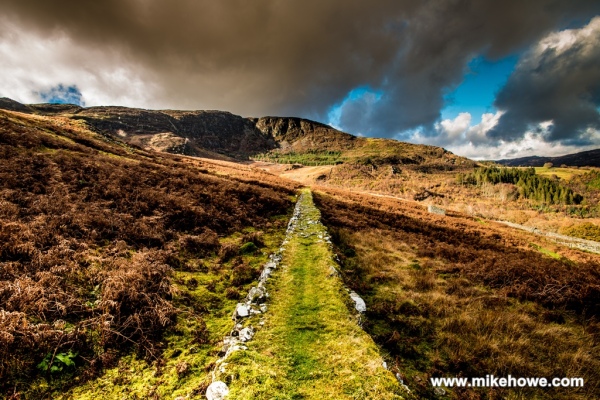
High up on the slopes of the Rhinogau (Rin-og-i), an isolated, rugged range of mountains forming much of the Harlech Dome in North Wales, lies a 19th century gold mining complex. All that remains of the hard toil of the men and women of the time are some deep,cavernous mine shafts which drip with the rain from the mountains, a few ruined buildings and the old track that was used to transport the rock for processing.
Photo: Mike Alexander
Since all the industry left the hillside, nature has quietly taken over again, so that now the only sound you hear up there is the sighing of the wind and the throaty call of the raven in his craggy domain. The noise and disruption of the past is long gone, along with all the stories of the people who worked this land in order to provide a living for their families.
The land is now cared for by the National Trust, and I have had the privilege to write the plan for its future conservation. There’s plenty more to see at this place, and I’ll update you as I go. I’ll be back there next week.
So in composing the music for my album “Heading West”, which is essentially a travelogue about my journey across America, I wrote a song called “San Francisco” which leaned heavily on my love of jazz and jazz fusion. I wanted to paint a musical picture of a cityscape, something that talked of vibrancy, excitement and a little edginess, and contrasted with the more peaceful sounds I had written on the album to capture great landscapes. San Francisco is such a beautiful, exciting city to visit, I felt compelled to write music about it.
I also wanted to put together a video essentially to showcase the music. What I ended up with, however, was something different – a video showcasing the amazing art of Jeremy Mann, who has painted some of the most beautiful and evocative cityscapes that I have ever seen of his hometown, San Francisco. See what you think here….
In his creative practice, Mann aims to imbue his city with drama, mood, and personality. He paints his immediate surroundings with intimate, dynamic expression. A number of his compositions are inspired by wet pavement that reflects street lamps and neon signs and glitters in the rain.
Painting on medium-to-large scale wood panels, Mann utilizes a number of techniques: staining the surface, wiping away paint with solvents, and applying broad, gritty marks with an ink brayer. He paints with confidence and flair, addressing complex compositions with colors both vivid and atmospheric.
I love his work. And so, actually, my song is dedicated to him and I hope it does his work justice, even in a very small way.
I have been exceptionally lucky recently to have been asked to prepare a conservation management plan for the estate at Dinefwr (Din-ev-or) near Llandeilo in West Wales, which is owned and cared for by the National Trust.
It is quite a difficult task to paint a verbal picture of Dinefwr and it isn’t possible to convey the importance of the place in strictly factual terms. It’s only when you are lucky enough to visit Dinefwr that the sheer unusual beauty of the place strikes you in a way that the words that you have read cannot. It is a very, very special place indeed.
Dinefwr is of exceptional significance for its archaeology, designed landscape and buildings. The present day landscape was set out by George Rice and his wife Cecil with some assistance from Lancelot ’Capability’ Brown in the second half of the 18th century. It has been widely admired ever since with impressions recorded by means of painting, sketching and the written word – it even appeared on a dinner plate, part of a service commissioned by Catherine the Great.
Today the park is widely acknowledged to be one of the finest designed landscapes in the UK. At its centre is Newton House, originally constructed in the 17th century to a simple but elegant design, it was encased in limestone to a Venetian-gothic design in the 1850s.
Photo: Mike Alexander
Trees and open grassland are so important to the appearance and aesthetic qualities of Dinefwr’s landscape and they were deliberately set out as part of the landscape design, with most of the trees planted on the higher ground and the grassland occupying the valleys and the areas immediately adjacent to the house and the main drive.
Archaeological surveys have, inevitably, revealed evidence of earlier landscapes including the defensive structures of an Iron Age fort and most remarkable of all, two overlapping Roman forts. Faint earthworks mark the outlines of tracks and field boundaries that predated the construction of the deer park in the middle of the 17th century.
One of the most significant archaeological monuments in the park is Dinefwr Castle. The 12th century stone buildings and walls seen today apparently replaced an earlier timber structure dating to the 8th century. This castle was the capital of most of west and south Wales in the 12th century so the surrounding woodland and park must conceal evidence of medieval tracks and paths.
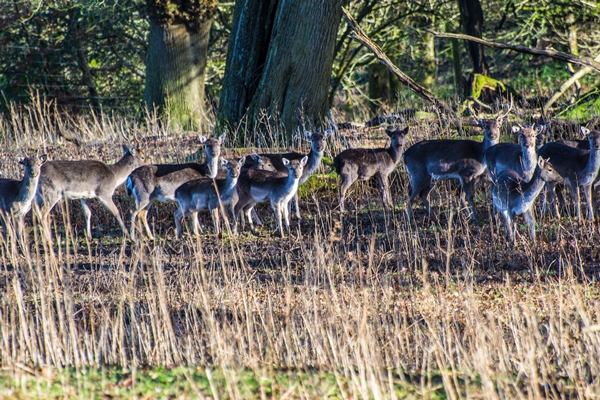
The park is well known for its fallow deer and, in particular, its white park cattle – a rare breed restored to the park in 1992 after a long absence, but that can be traced back to Dinefwr from at least 1000 years ago.Both the deer and the cattle are integral to the historic park in their own right, but also because they maintain a complex mosaic of ancient grassland habitats.
Ancient white park cattle Photo: Mike AlexanderFallow deer herd Photo: Mike Alexander
One of the most striking features of the grassland in the deer park is the abundance of yellow meadow ant hills, which indicates how undisturbed this grassland has been for centuries.
Photo: Mike Alexander
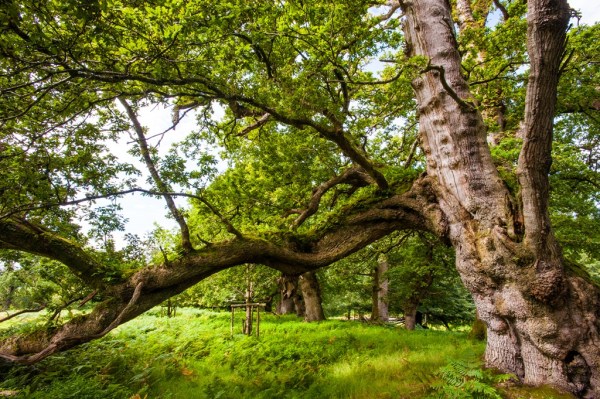
In some parts of the park there are remnants of medieval woodland featuring many ancient trees that are at least 400 years old. And at its core, this wood pasture is dominated by nearly 300 huge oak trees, including some of the oldest and largest trees in the UK – one, the Castle Oak, is thought to be over 700 years old.
700 year old oak tree Photo: Mike Alexander
Dinefwr’s ancient trees, important in their own right, are host to a remarkable assemblage of wood decay invertebrates including 400 “saproxylic” beetle species, 26 of which are classified as nationally scarce. More than 160 species of lichen have been recorded in the park, several of which indicate a long history of ecological continuity.
The assemblage of breeding birds at Dinefwr is very impressive, and some of the most important are the lesser spotted woodpecker, an increasingly rare species in the UK, as are the green woodpeckers, which thrive on the impressive colonies of yellow meadow ants, conspicuous by the presence of hundreds of ant hills in the deer park grassland. Other notable bird species breeding in the woodlands include tawny owl, tree creeper, sparrowhawk, tree sparrow, jay, long-tailed tit and pied flycatcher.
On the lakes, ponds and ditches of the Towy floodplain greylag geese, Canada geese, swan, widgeon, goldeneye, heron and snipe amongst many others can been found year round.
My fourth album “Heading West” is an interpretation of the landscape and peoples of the American west through the senses of a travelling Brit. I wanted to express the emotions of my experiences and to convey the character of the places that I visited, although some of the music I composed turned out to be more abstract than that.
One example of this is my song “Hope”. I’ve had some really lovely comments about this song which is always nice because you never know whether or not what you are doing is perhaps a cliche – the listener always decides this of course. “Hope” is not easy to describe, which is why I gave the song that title after I had composed and recorded it – if one word can describe an abstract thing like a piece of music, then “Hope” was it in this instance.
When it came to putting together a video for this song, I started trawling aimlessly on the internet looking for inspiration. It wasn’t long before the amazing photographs of Dorothea Lange jumped out at me as the perfect representation of what the song is about.
Dorothea Lange (1895 – 1965) was an amazing American documentary photographer and photojournalist, best known for her depiction of the Great Depression era which affected the world in the decade immediately preceding World War II. Lange’s photographs humanized the consequences of the Great Depression in the American west and documented the migration of so many people intent on finding work and a place for themselves and their families.
In 1941 Lange was awarded a Guggenheim Fellowship for her excellence in photography.
The picture on the video thumbnail is entitled Migrant Mother, and the woman is Florence Owens Thompson. Look her up on wikipedia, the story of how the picture came to be taken and of her life is fascinating. I hope you like the video and the music.
This is the place, according to Welsh legend, where the red dragon of the Celts fought with the white dragon of the Anglo-Saxons. Both fell into the lake, but only the red dragon emerged, and this is why the red dragon is the national emblem of Wales and appears on the national flag. But that’s only a story, albeit a nice one. I have written the management plan for this place and this will hopefully help to conserve the wonderful wildlife and the cultural landscape for the future. And it in turn has inspired some of my music.
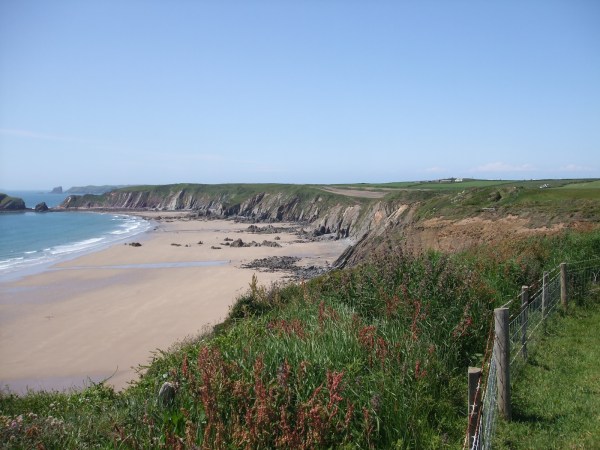
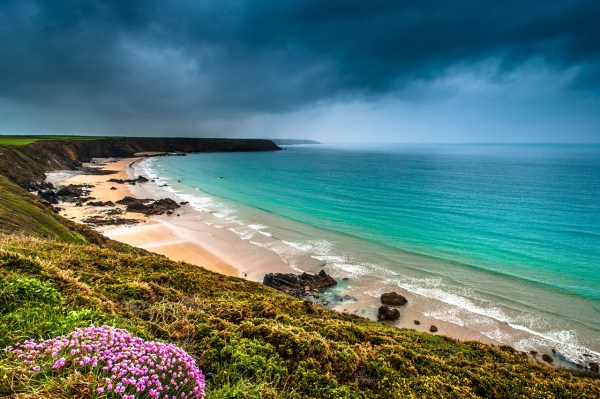
After 6 months of perpetual grey skies and torrential rain, spring has finally arrived on the Pembrokeshire Coast, and today our local beach looks like this. It’s so nice to finally feel some warm sunshine, although admittedly there is still a chilly north-easterly wind coming down from the arctic.
Puffins on Skomer Island, Pembrokeshire Photo: Mike Alexander
The sea birds have arrived back from the South Atlantic to breed on the offshore islands of Skomer, Skokholm, Grassholm and Ramsey. These puffins nest in dis-used rabbit burrows on the islands, which are free of predators like rats and foxes, although the threat from the Great Black-backed Gull is still very real for the offspring of these little fellas.
Photo: Mike Alexander
The gannets have returned from their winter feeding grounds in the south to breed in huge numbers (32,000 nesting pairs) on Grassholm Island, and can be seen diving into the sea wherever they spot shoals of fish on which to feed.
Photo: Mike Alexander
In the next few weeks all of the spring flowers will emerge as the land awakens from its winter slumber. The most familiar birds to be seen from the cliff tops are razorbills, guillemots, kittiwakes, fulmars and various species of gull, as well as shags, cormorants and the rarer choughs and peregrine falcons.
My music is often derived from and about some of the lovely places and wildlife of the Pembrokeshire Coast National Park in West Wales, where I have worked as an ecologist for 20 years. I hope it is possible to hear the influence of this landscape in my song, which was deliberately written in a style evoking a kind of “national anthem for nature”, if that makes any sense? Anyway I hope you like it 🙂 The song is from my album “Round River”.
Although it is rarely seen, the remnants of a past forested landscape, where there is now sea and beach, is a very interesting feature and teaches us about past sea level rise and our recent glacial history, and makes sense of some of the archaeological remains we find around our coastline in West Wales.
At the end of the last glaciation the sea level was much lower than it is today because so much water was still locked up in the ice sheets to the north of Britain. As the climate warmed forests became established on land that had been tundra for thousands of years, and this forest extended far out beyond where sea level is today. Gradually as temperatures rose, the sea ice to the south of the arctic circle melted and sea levels rose, submerging much of the coastal forests.
In some places this action was very rapid and sand covered and then preserved the remains. After heavy storms and at very low tides, peat or the stumps of these forest trees may be seen at places along the Welsh coast, particularly, in Pembrokeshire, at Newgale and Freshwater West.
Photo: Mike Alexander – The remains of a Scots pine trunk on the beach
The remains of animals and Mesolithic tools have been found in these deposits. These include an Auroch, which is an ancient cow and is the ancestor of all modern cows, a pig, a roe deer, a red deer antler and a brown bear jaw.
At Lydstep Haven, a pair of broken flint microliths were found by the neck vertebrae of a pig. This pig may have been injured, but not caught by its Mesolithic hunters and subsequently died in the forest. A tree trunk fell on its remains, preserving it, and the microliths in situ. This find has been dated to about 6000 BC.
Geraldus Cambrensis (Gerald of Wales ) noted the uncovered submerged forest, during his tour of Wales in AD 1188.
‘We then passed over Newgale sands at which place a very remarkable circumstance occurred. The sandy shores of south Wales laid bare by the extraordinary violence of a storm, the surface of the earth, which had been covered for many ages, reappeared, and discovered the trunk of trees cut off, standing in the very sea itself, the strokes of the hatchet appearing as if made only yesterday. The soil was very black and the wood-like ebony. This looked like a grove cut down, perhaps at the time of the deluge, or not long after.’
We cannot be sure whether the marks he saw were made by a stone axe. It is certainly possible, since stone axes were in use before the forests were submerged between about 6000 and 5000 BC.
He made these observations 800 years ago and similar observations are the basis for medieval traditions about the Cantref Gwaelodd – ‘the lost lands of Wales.’
This is what the beautiful coastline looks like today….









 Mike Howe